Investments tied to artificial intelligence and high technology are becoming an increasingly important force in US capital spending and industrial production. However, that growth is concentrated in a relatively narrow group of technology-related markets.
Other investment categories and industrial sectors are growing much more slowly or remain below year-ago levels. For business leaders, strong headline investment data may be providing an incomplete picture of the cycle that is affecting their customers and markets.
Technology Is Leading the Investment Cycle
Recent data shows substantial differences across real fixed investment categories. Information processing equipment, software, and research and development are all in Phase C, Slowing Growth, meaning that activity remains above year-ago levels while the pace of rise is diminishing.
Industrial equipment is in Phase B, Accelerating Growth. Transportation equipment and nonresidential structures are in Phase A, Recovery, meaning that their rates-of-change are rising even though activity remains below year-ago levels.
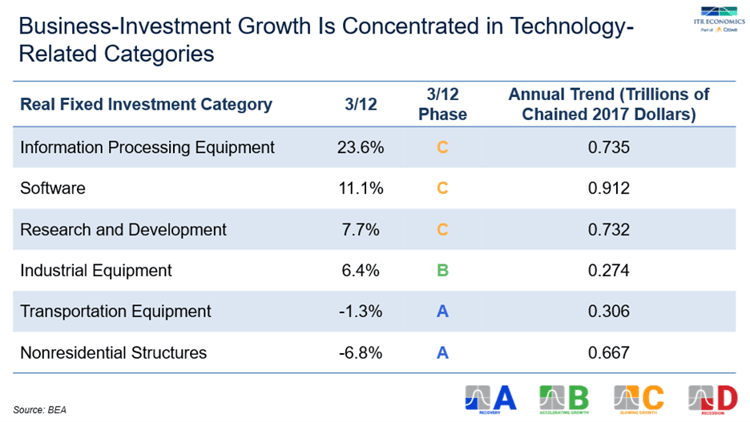
Figure 1: Information processing equipment, software, and research and development are leading fixed-investment growth, although all three are in Phase C, Slowing Growth.
These divergences illustrate that the investment cycle is moving along different tracks. Tech-related categories are posting the strongest growth, though momentum is easing. Industrial equipment is accelerating at a more moderate pace, while transportation equipment and nonresidential structures —both of which have been negatively impacted by high long-term interest rates — are beginning to recover from contraction. The next stage of the cycle will depend partly on whether those recovering categories gain enough momentum to broaden the expansion before growth in the leading technology categories slows further.
High-Tech Production Is Pulling Away
A similar divide is visible within the industrial sector. US semiconductor production is up 30.1% on a 12/12 (year-over-year) basis, while electronic components production is up 12.9%. Total US Industrial Production, by comparison, is only 1.3% above the year-ago level.
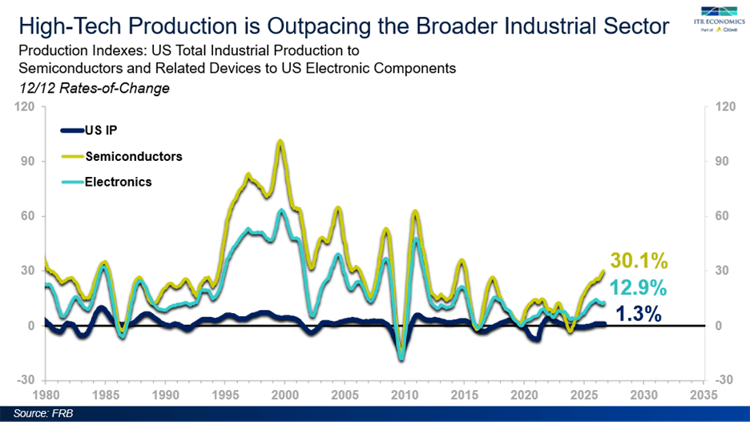
Figure 2: Semiconductor production is up 30.1%, and electronic components production is up 12.9%. Compare this to 1.3% growth in total industrial production.
Semiconductors and electronic components support a wide range of end markets, so these series capture broader high-tech activity rather than AI demand alone. Even so, their growth illustrates how much of the current industrial momentum is concentrated in technology-related industries.
A supplier serving semiconductor manufacturers, electronics producers, or related infrastructure markets may be experiencing a much stronger cycle than the total industrial production figure suggests. A business with limited exposure to high technology may be seeing much more modest demand. For those segments tied heavily to discretionary spending and interest rates — housing, automotive, and RV come to mind — the outlook is decidedly weak. The same national economy can therefore produce very different market cycles for businesses with different industry exposure.
Will Growth Broaden?
For business planning, leaders need to know whether the strength in high technology will spread into other investment and industrial categories. Continued acceleration in industrial equipment, accompanied by a stronger recovery in transportation equipment and nonresidential structures, would suggest that the investment cycle is becoming more broad-based. Limited improvement in those categories would leave aggregate growth more dependent on technology-related markets.
The Phase C, Slowing Growth, position that the leading investment categories are in also deserves attention. Businesses exposed to high-tech investment may continue to benefit from elevated demand, but today’s growth rates should not be carried forward indefinitely in capacity or sales plans.
Plan for the Market You Are Actually In
High tech is leading the current economic cycle, while growth across the broader economy remains uneven. Business leaders should align their hiring, inventory, capacity, and capital-spending decisions with the rates-of-change in the markets they serve.
Management teams should also quantify how much of their revenue, backlog, and planned investment depends on high-tech demand. From there, they can establish decision triggers tied to leading indicators, allowing changes in orders, utilization, or customer activity to prompt timely adjustments to budgets and expectations. Scenario plans should account for both a broader economic expansion and a faster slowdown in technology-related markets, with particular attention to customer concentration and the risk of building permanent costs around temporary rates of growth.
Broader economic conditions provide useful context, but company-specific leading indicators should guide the plan. The objective is to translate changing economic signals into pre-established actions before market conditions force a reaction.
At ITR Economics, we help businesses look beyond headline economic data and incorporate leading indicators into practical, profitable decision-making. Contact us today to speak with a trusted advisor and learn how economic analysis can support your long-term planning.