Strong corporate profits mask financial pressures that could constrain small business investment in 2027.
US corporate profits are at record highs, suggesting businesses have the financial capacity to invest and expand. However, aggregate figures may conceal a more challenging environment for smaller firms. A broad credit squeeze is not yet evident; however, rising bankruptcies and tightening lending standards for small businesses suggest that the financial pressures on these businesses are building, potentially creating uneven capital investment trends in 2027.
How Have Credit Standards Changed?
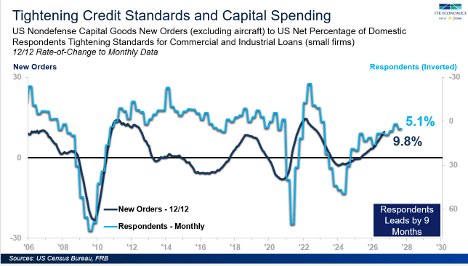
The Federal Reserve's October 2026 Senior Loan Officer Opinion Survey (SLOOS) suggests banks may be becoming somewhat more selective in lending to smaller businesses, with a modest net percentage (5.1%) reporting tighter commercial and industrial lending standards for small firms, compared to little net change for larger businesses.
Most banks reported no change in standards, suggesting credit availability is not deteriorating broadly. However, the slight increase in tightening standards warrants monitoring, particularly as economic growth moderates. Among banks reporting weaker demand, most said reduced investment in plants and equipment was a contributor. The findings suggest limited broad-based tightening alongside softer demand at a subset of banks. Historically, this credit standards measure leads capital goods orders through the business cycle by about three quarters, so the latest tightening of standards warrants monitoring.
Are Rising Bankruptcies Signaling Financial Stress?
US business bankruptcy filings increased 12.5% in the 12 months through September 2026, while small-business Subchapter V bankruptcy elections increased 24% year over year in October 2026, following a 46% increase during the first nine months of the year.
These trends suggest growing financial strain among some businesses, but they need to be taken with a grain of salt. Bankruptcy statistics require context, given that they can be distorted and are not always a clear macroeconomic signal. Large corporate restructurings can generate multiple filings, and changes in bankruptcy eligibility can influence the timing and volume of filing activity. Bankruptcy trends do not necessarily reflect broader economic conditions, as filings disproportionately capture financially vulnerable businesses rather than a representative cross-section of the economy. Further, while bankruptcies are moving higher, the aggregate level of bankruptcies appears to be benign at this time.
Nonetheless, rising bankruptcies, alongside a slight tightening in small-business lending conditions, warrant some caution. We will be watching carefully to see if the effect broadens going forward.
Could Business Investment Become More Uneven?
Small businesses account for approximately 43.5% of US GDP, 45.9% of private employment, and 35.0% of private-sector receipts, according to the Small Business Administration.
While aggregate corporate profitability remains strong, larger firms may be better positioned to finance investments internally, and profitability is uneven across sectors (the so-called “K-shaped” economy effect applies to profits, too). Smaller businesses are often more sensitive to borrowing costs, credit availability, and changes in customer demand.
We anticipate slowing consumer spending and mild decline in business-to-business spending during the second half of 2027. These conditions could constrain investment among financially vulnerable firms, even as stronger businesses and those tied to high-tech industries continue investing in automation and productivity improvements. The primary risk is less a broad-based, sharp decline in investment, and more a widening gap between well-capitalized firms and more vulnerable small businesses.
What Should Small Businesses Do?
- Evaluate Financing Needs: Review credit availability and refinancing schedules before demand softens.
- Assess Customer and Supplier Exposure: Monitor financial conditions among smaller business partners, including payment trends and order volumes.
- Prioritize High-Return Investments: Focus on productivity-enhancing projects and use scenario planning to evaluate investment decisions under different demand and financing conditions.
At ITR Economics, we combine economic forecasting, industry intelligence, and customized analysis to help business leaders understand how shifts in demand, lending conditions, and their markets may affect the business environment. Our data and analysis can inform your planning. Contact us to learn more about how ITR’s economic insights can support your understanding of the outlook.