The global government-bond sell-off has spread across major markets, including the United States, and it’s sending a strong message: long-term borrowing costs are under renewed upward pressure. The 10-year Treasury Yield started the year around 4.2% and has climbed to around 4.8% as of September 1, the highest level since January 2025.
What Is Driving the Recent Bond Sell-Off?
The bond market is balancing several forces at once.
- The US economy is still growing, but much of the strength remains concentrated in the technology sector.
- At the same time, inflation is proving persistent amid escalating Middle East conflict and high global oil prices.
- Concerns over government debt loads — not just in the US but also in Japan, the UK, and France — are also a contributing factor. Investors are being asked to absorb a large supply of government debt to fund deficits and refinance maturing obligations.
Higher yields reflect more than expectations for the Federal Reserve’s next decision. Treasury yields influence the rates businesses pay on corporate bonds, commercial loans, and other forms of long-term credit. Our forecast for US Government Long-Term Bond Yields, which is available in our Trends Report subscription, has been calling for gradual interest rate rise ahead. While others were distracted earlier this year by the prospect of a more dovish incoming Fed Chair, we warned our clients about the higher long-term interest rates coming.
The US Treasury Is Taking Steps to Support Market Liquidity
In direct response to pressure in the long end of the Treasury market, the US Treasury doubled the maximum size of its liquidity-support buybacks for 10-to-30-year securities. The purchases are intended to improve trading conditions and prevent market dysfunction, but they do not reduce federal borrowing needs or resolve the inflation, debt-supply, and fiscal concerns that are pushing long-term yields higher.
Corporate Credit Markets Tell a More Encouraging Story
Higher yields do not mean credit markets are preparing for a recession. Corporate lending indicators provide an important counterpoint to rising government bond yields.
The spread between higher- and lower-rated corporate bonds has been declining since mid-2025. This narrowing credit spread means lenders are not particularly concerned about risk of defaults and economic weakness. Credit spread is shown inverted in the chart below relative to US Nondefense Capital Goods New Orders (excluding aircraft).
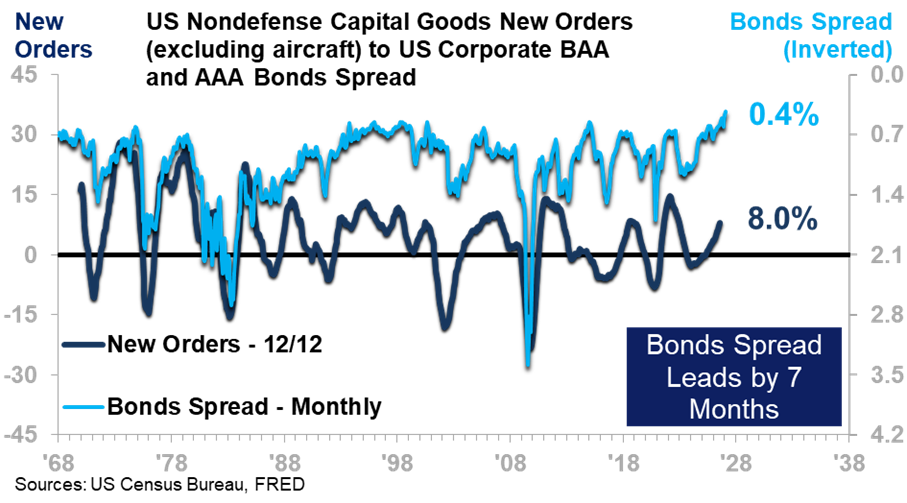
The recent narrowing is effectively a vote of confidence in the macroeconomy. Investors are demanding higher yields for duration and inflation risk, but they are not signaling broad concern about the ability of businesses to service their debt.
The July Senior Loan Officer Opinion Survey supports that interpretation. Respondents reported narrowing spreads and stronger demand for commercial and industrial loans. In other words, businesses are still seeking capital, and banks appear willing to compete for qualified borrowers.
What Businesses Can Do
The recent sell-off should prompt business leaders to revisit several areas of financial planning.
- If you will need to refinance in the future, model the effect of refinancing at current rates versus moderately higher future rates.
- Protect margins and cash flow. Higher interest expenses may arrive alongside elevated labor, energy, and materials costs.
- Evaluate funding options rather than focusing on a single benchmark rate. Strong borrowers may still find competitive financing terms.
- Plan for volatility. Success in the coming decade will require managing expectations with an eye for potential volatility. Test your plans against a range of rate scenarios.
The Bottom Line
The recent Treasury sell-off has pushed long-term interest rates higher and reinforced the case for a higher-for-longer financing environment. At the same time, narrowing corporate credit spreads and stronger commercial loan demand indicate that markets retain confidence in the broader economy. The businesses best positioned in the coming years will not be those waiting for yesterday’s interest rates to return, but those building resilient plans around the costs that capital markets are signaling today.
