Today’s CRE market looks different from the downturns of the past — and the risks have changed with it.
Following over a year of decline in construction spending, US Nonresidential Construction is nearing an inflection point. Commercial banks are accelerating their lending in the commercial real estate (CRE) space. With construction moving toward recovery, it begs the question: have we moved beyond the CRE downturn, or are financial risks still waiting ahead?
The data suggests that the worst fears of a broad CRE financial crisis have not materialized and that today's lending environment looks considerably different from the run-up to the Great Recession. However, the risks have not disappeared, and outcomes are highly uneven depending what segment of CRE you look at. For example, US Private Data Center Construction was 38.5% above year-ago levels in August amid an ongoing surge in AI investment. This contrasts sharply with US Private Office Construction (Excluding Data Centers), which has fallen approximately 30% in the wake of the COVID-19 pandemic. Meanwhile, Warehouse Construction and Education Construction are below year-ago levels, but they are signaling early signs of improvement.
Given interest rate pressures and that the significantly weaker economic environment of the 2030s is looming increasingly large in the windshield, investors should take steps to prepare for the downturn.
Four CRE Market Considerations
- Average CRE Loan-to-Values have risen, but they remain below Great Recession-era highs. According to MSCI, average LTVs were 65.9% across the CRE lending sample in the first half of 2026, up from 64.2% in the prior year. Based on industry sources, this likely represents a notable rise from average LTVs in 2023. That warrants monitoring; however, current leverage remains below the levels observed leading up to and during the Great Recession.
- US Government-Sponsored Enterprises (GSEs) are a much larger part of CRE finance than they were in prior decades. Agencies and GSE, such as Fannie Mae and Freddie Mac, represented about 23% of commercial mortgage debt in Q2 2026, versus the roughly 8%–10% they represented in the years leading up to the Great Recession. The shift has generated a relatively stable funding channel but added a potential point of concentrated risk within government-supported institutions. Nonetheless, recent lending data does not suggest that agency and GSE financing is unusually aggressive.
- Multifamily is the largest component of the CRE debt mix. Multifamily represented roughly 25% of CRE mortgage debt in 2008, and today it is about 38%. That makes the current CRE market structurally different from the one entering the Great Recession. Multifamily performance now matters much more to overall CRE credit risks.
- Private-label securitization remains below pre-crisis levels. MBA data shows securitized debt at about 13% of total CRE debt in Q2 2026, or $651 billion, versus roughly 22% in early 2007. Securitization activity has strengthened recently, but the market remains significantly less dependent on private-label securitized financing than it was before the Great Recession.
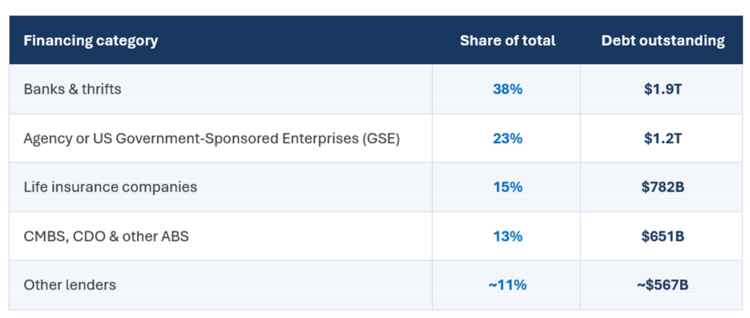 Q2 2026 US commercial and multifamily mortgage debt by financing category. Source: Mortgage Bankers Association.
The clearest vulnerability lies not in loans being originated today, but in older loans approaching maturity. Debt yields illustrate the difference: Trepp reported an average debt yield of 8.77% for the 2021 CMBS vintage versus 10.36% for 2026, meaning today's newly securitized loans generally have more property income supporting each dollar of debt. At the same time, higher interest rates have reduced debt-service coverage because borrowers must devote more of that income to interest and principal payments.
That creates refinancing risk. A property financed at a low rate several years ago may still generate adequate income but be unable to support the same loan balance at today's borrowing costs. The Mortgage Bankers Association estimates that approximately $875 billion of commercial and multifamily mortgage balances, or 17% of outstanding commercial mortgages, are maturing in 2026. Longer term, investors should not lose sight of the increased risks that high interest rates pose. If incomes drop and vacancies rise as we expect in the economic turmoil of the 2030s, we will likely see a wave of CRE defaults and lower asset prices.
What The Data Suggests
The evidence increasingly points toward recovery rather than an approaching system-wide CRE crisis. LTVs remain below pre-Great-Recession extremes, new loans generally have strong debt yields, private-label securitization represents a smaller share of the market, and financing availability is accelerating. Yet the recovery will not be uniform across property types, and legacy loans still face lower valuations and substantially higher refinancing costs.
The bottom line: The makeup of the CRE market has changed meaningfully, and while the CRE market has proven relatively resilient to higher rates overall, longer term those risks have ratcheted up. Overall, CRE appears to be moving beyond its most acute period of financial stress, but the adjustment is not over. For businesses tied to nonresidential construction, the improving availability of credit backdrop is encouraging; the key risk to be watching is how successfully the market works through older debt as it matures. We urge investors to focus on preparing their CRE profile to withstand the significant pressures the 2030s will pose to investments — if you need help assessing your property portfolio’s exposure, reach out to us.