Consumer spending remains resilient, but weakening income growth paired with less supportive savings and credit conditions point to slower activity in 2027.
Consumer spending remains one of the more dependable sources of US economic growth. Even as households face higher prices, elevated interest rates, and growing financial pressure, retail sales continue to expand.
However, that resilience appears to be softening as the underlying sources that allow consumers to spend are losing momentum. Real personal income growth is weakening, while savings and credit conditions are becoming less supportive. These trends portend more noticeable slowing in consumer activity next year.
Income Growth Is Losing Momentum
Consumer spending ultimately depends on the ability and willingness of households to spend. Income is, of course, a critical part of that equation.
Recent data shows that real personal income (excluding current transfer receipts) growth is slowing, rising only 0.2% over the past 12 months, while the shorter-term quarterly rate-of-change is –0.3%. A negative quarterly growth rate shows that incomes are tentatively declining on an inflation-adjusted basis, even though the longer-term measure remains slightly positive.
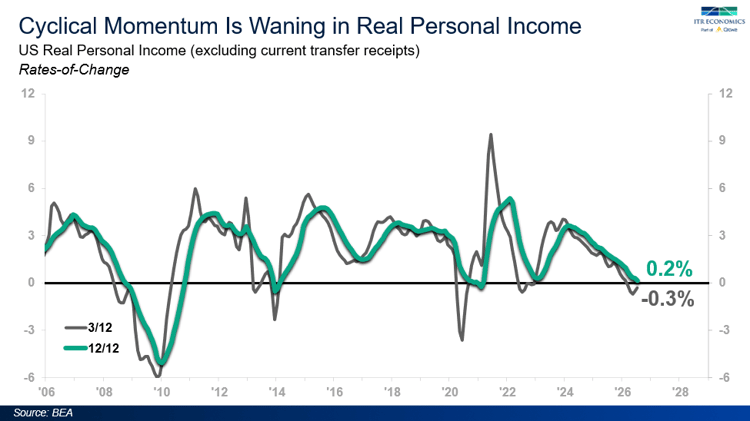
Figure 1: Real personal income excluding current transfer receipts shows weakening cyclical momentum.
These metrics indicate that consumers have less income growth available to support additional spending, which typically results in households reducing their discretionary purchases or relying more heavily on savings or credit to maintain their current consumption patterns.
Savings and Credit Conditions Point to Slower Activity
The ITR Indicator for Consumer Access to Savings & Credit provides another perspective. This indicator leads retail sales by approximately 12 months, making it useful for evaluating the direction of future consumer activity.
With the current annual growth rate flattening at 0.3% after a period of deceleration, the indicator suggests that the pace of consumer activity could cool as households encounter less support from savings and credit.
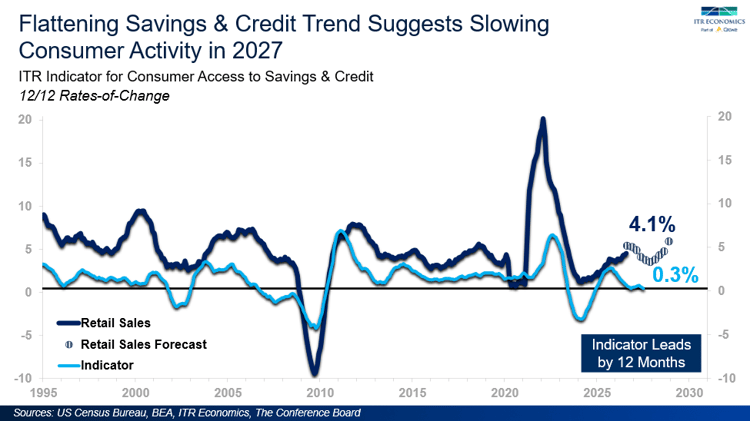
Figure 2: The ITR Indicator for Consumer Access to Savings & Credit leads retail sales by 12 months and points to slower consumer activity in 2027.
These trends are particularly relevant for businesses selling directly to consumers. While revenue growth is still possible, the overall market will be less supportive. Businesses will be responsible for their own destiny by discovering opportunities.
Higher-income consumers may have greater savings, stronger balance sheets, and more flexibility to continue spending. Lower- and middle-income households are generally more exposed to essential costs, including housing, food, transportation, and health care. When those expenses consume a larger share of income, there is simply less money remaining for discretionary purchases.
Businesses that serve value-oriented consumers may therefore face a different environment than those serving higher-income consumers.
What Businesses Should Watch in 2027
While headline retail sales growth shows the broad direction of consumer activity, whether consumers have the income, savings, and credit capacity to sustain current spending patterns is more important.
Key indicators to watch include:
- Real personal income (excluding transfer receipts)
- Consumer access to savings and credit
- Credit card and consumer loan delinquencies
- Retail sales growth by category
- Spending trends among different income groups
- Evidence of increased reliance on revolving credit
Companies exposed to discretionary consumer spending should consider how a slower environment would affect sales volumes, product mix, pricing, and inventory decisions. A business may not need to prepare for a broad consumer contraction, but it should be prepared for more selective and price-sensitive demand.
The same conditions may also create opportunities. Businesses that offer value, essential products, repair services, financing alternatives, or lower-cost substitutes may benefit as consumers adjust their priorities.
Preparing for a More Selective Consumer
Businesses do not need to plan for an immediate collapse in consumer demand, but they should be prepared for slower and less predictable growth. Those that depend on discretionary spending may need to reassess sales forecasts, inventory plans, pricing strategies, and investment decisions before the slowdown becomes fully visible in headline retail sales data.
The broader lesson is that consumer strength should not be judged by retail sales alone. When income growth loses momentum and access to savings and credit becomes less supportive, today’s resilient consumer can quickly become tomorrow’s more cautious consumer.
The organizations best positioned for that shift will be those that recognize the change early and adjust while demand is still growing — not after it has weakened.
At ITR Economics, we help businesses look beyond headline economic data and incorporate leading indicators into practical, profitable decision-making. Contact us today to speak with a trusted advisor and learn how economic analysis can support your long-term planning.
