News
ITR Economics' Perspective
ITR Economics provides the best economic intelligence for practical and profitable business decisions.
Understand how oil price trends impact business planning and profitability, and learn strategies to navigate volatility in the energy market.
The oil market has been volatile since conflict in the Middle East disrupted production and sharply reduced trade through the Strait of Hormuz. That disruption has kept oil in the headlines and raised concerns about costs across transportation, manufacturing, packaging, and other energy-sensitive parts of the economy.
It is tempting follow each new development and treat it as a lasting shift. For business planning, however, the underlying trend matters more than the latest headline.
When the conflict intensified, ITR Economics revised its outlook to account for the disruption and the risk to global oil flows. Even then, our analysis of prior wartime disruptions to oil markets indicated the price spike would be temporary, followed by easing later in the year. Our forecast, which has not changed since it was put in place in early March, followed suit. So far, the market has broadly followed that path. Through June, the Oil Prices forecast has yielded 99.1% forecast accuracy on a 3-month moving average basis.
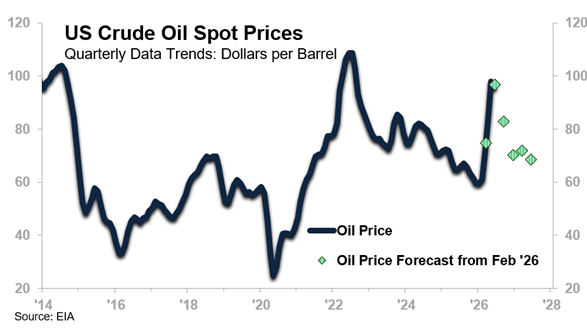
The purpose of our forecasting is not to predict every market movement or daily price movement. It is to provide a reasonable baseline and identify the factors that could change the outlook. For oil, those factors include the duration of the conflict, trade through the Strait of Hormuz, damage to production or distribution infrastructure, available inventories, and the response that producers will have. Tracking those structural drivers gives businesses a clearer sense of where the market is heading and what could cause the outlook to shift. It also helps distinguish a temporary reaction from a more durable change in direction.
Oil prices affect more than fuel costs. Freight, packaging, petrochemical inputs, utilities, and supplier pricing can all feel the impact. The right response is to understand where those costs show up in your business and which areas are most exposed if volatility continues. Hedging, escalator clauses, supplier reviews, and selective reductions in energy use may help protect margins while geopolitical risk remains elevated.
Domestic producers have shown some willingness to increase drilling in response to the temporary spike, but the response has been generally limited. Businesses tied to upstream activity should therefore be cautious about assuming a lasting increase in investment.
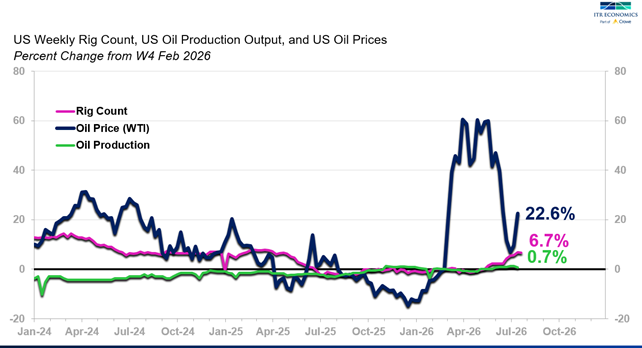
The conflict caused a sharp oil-price shock, but the broader path has remained consistent with the forecast: a temporary spike followed by general easing. The main upside risk remains a prolonged disruption to the Strait of Hormuz or significant damage to production and distribution infrastructure. Without either development, the current trend points to further moderation.
For business leaders, the next step is to use the forecast as a planning basis. Review where oil prices affect your costs, demand, and capital decisions, and identify which structural changes would warrant a shift in strategy. That approach helps keep short-term headlines in perspective while giving you a clearer framework for what comes next.

ITR Economics provides the best economic intelligence for practical and profitable business decisions.
ITR Economics is projecting that the disinflation will continue to be uneven but still yield lower inflation as we progress through 2024.
Learn the distinctions between economic recessions and depressions and how to prepare your business for the impending 2030s Great Depression.