The next decade is not going to favor all states equally, nor will the state-level patterns of this decade necessarily continue into the next. Businesses and investors that fail to recognize this may find themselves swimming upstream against demographic headwinds they did not anticipate.
Population growth is one factor that drives future growth potential for businesses. People (or as some economists like to cold-heartedly call them, “consumption units”) are drivers of spending, and spending is fuel for economic growth. Most people think of this at the country level. For example, the news has consistently documented the struggles of the Chinese and Japanese economies as those nations face population declines. What gets less airtime — but is no less true — is that population growth matters at the state level. Population growth and the demographic composition of each state are such fundamental factors of economic potential that we include it as a primary pillar in the ITR State Opportunity Index.
Low population growth translates to constrained opportunity in most cases. Looking at a snapshot of the last three years, there are three states that are population losers and many more that are growing slower than the US population growth rate of 2.1%. Based on this map, we would expect that businesses trying to grow in Vermont, West Virginia, and Hawaii will be swimming against the tide.
Stronger Fundamentals in States With Higher Growth Rates
Population Growth by State 2022 - 2025
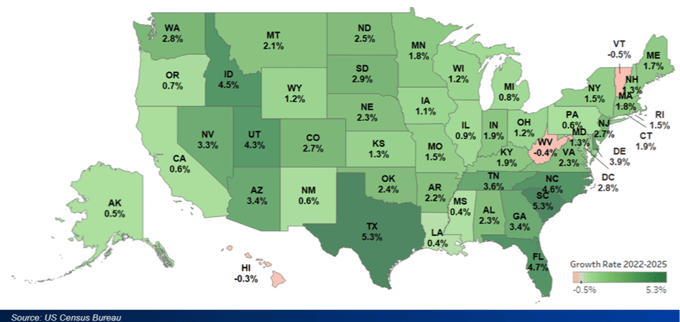
Planners need to zero in on the factors that move the needle. In addition, they have to consider whether the slice of data they are using is representative of the trend that will extend into the 2030s. We created the ITR State Opportunity Index to focus on the factors that matter for most businesses. For the population metric, that meant zooming out and looking at a longer-range view of population change that was less skewed by post-COVID economic shifts that may not persist through the rest of the decade.
Longer View to Normalize COVID Effect
Population Growth by State 2015 - 2025
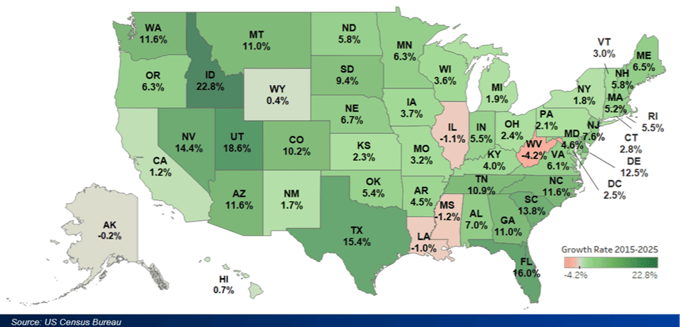
Taking a 10-year slice of the data instead shows that Illinois, Mississippi, and Louisiana are longer-term losers when it comes to state population. These states account for 5.4% of US GDP. That amount is not trivial.
In the prolonged downturn we expect in the 2030s, those disadvantages become magnified. Companies without a clear competitive advantage may find themselves fighting against structural headwinds for years. Consider making investments now to solidify your market position, because prospering in the decline of the 2030s will require a clear vision of what sets you apart.
Challenges are not limited to lower-growth states. High-growth states may offer stronger baseline conditions for customer acquisition and labor availability, but rapid growth also creates infrastructure strain, housing pressures, and rising operating costs. Businesses that assume that recent migration trends will continue indefinitely may be exposed to unnecessary risk. Strategic diversification and disciplined market selection will matter more in the 2030s than they have in decades.
Is your business model highly dependent on population migration? If so, consider strategy shifts that will diversify the business. For example, new home builders in Texas or Florida may not see the same level of opportunity going forward, because homeowners who secured low mortgage rates during the COVID era may be less willing to move. An appropriate pivot for a business like this might be to begin shifting focus toward developing expertise in renovations.
Check out our recent webinar, Winning US States for the 2030s: Where to Invest, Where to Exit, and What to Do Now, where we introduce the ITR State Opportunity Index and break down:
-
Which states are positioned to outperform in the 2030s
-
Which regions may face elevated economic risk
-
How businesses can align expansion and investment decisions with long-term trends
