Clients have been asking a lot of questions about oil prices and their economic impact lately. Where are prices headed? How will consumers handle the shock of higher energy costs? Is there a price point at which oil prices begin to adversely impact the economy? How should I plan for inflation? Here is what we want you to know.
Executive Summary: Economic concern is less about how high oil goes and more about how we are seeing an oil price shock coincide with weak real income growth. In the meantime, there are a multitude of levers you can pull to help your business.
What Does the Data Say Happens During and After Extreme Oil Price Shocks?
Daily oil price data extends back to roughly 1983. Since that time, we have seen 10 events associated with at least one 20% increase in oil prices over a five-day stretch: three wars (the 1990 Gulf War, the 2022 Russia-Ukraine War, and today), three OPEC-related events, volatility surrounding two recessions (the Great Recession and COVID-19), a mid-1990s inventory imbalance, and the Exxon-Valdez oil spill.
Focusing on the two previous wars, there is a degree of consensus: monthly average prices peaked within the first three to four months, then gave up most, if not all, of the gains in the ensuing three or so months. The degree of increase was substantially different — 93% in the case of 1990 and 25% in the case of 2022. That reflects differences in:
- Where oil prices were prior to war (low, in the case of 1990, making it easier to rise higher; prices were already elevated in the case of 2022)
- Dynamics of the war itself (fought in the Middle East, in or near a multitude of oil-producing nations, versus outside it)
- How globalized the oil market was (not as globalized in 1990 as 2022)
Bottom line:
The inelastic nature of oil demand means that the price ascent and the price descent are both likely to be steep. Relevant historical precedents suggest this oil price shock will likely be measured in weeks or months, not quarters or years.
Management ObjectiveTM:
Avoid linear thinking.
What Is ITR Economics’ Oil Forecast?
We forecast quarterly prices (a three-month moving average), not daily prices, so our clients can plan with stability. At the time of publishing, our forecast calls for quarterly prices to peak for the three months ending in May at $99/BBL, then decline to an average of $70/BBL by the fourth quarter of this year. The 62% increase in quarterly prices from the pre-war average of $61/BBL to the peak of $99/BBL is not as severe as the jump during the 1990 Gulf War, but it is more severe than the 2022 Russia-Ukraine War.
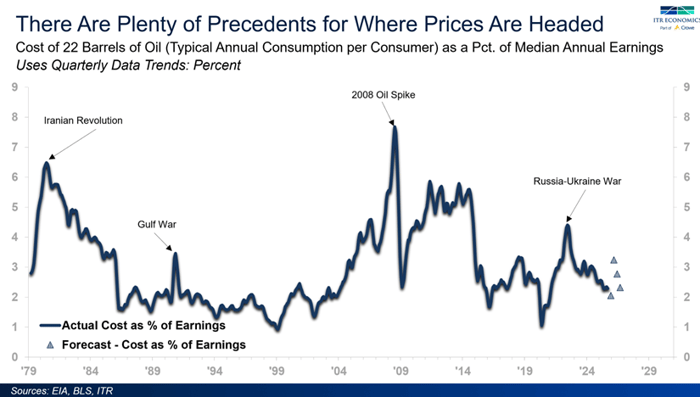
To see how this will impact consumers, we do a comparison of oil consumption costs to consumers’ ability to pay. The typical American consumer accounts for around 22 barrels of oil consumption per year. Using our oil price forecast and median annual earnings forecast, we can see the comparison of the cost of 22 barrels of oil relative to median income shows this price surge is (1) certainly notable, but also (2) significantly less severe than prior price surges, such as 1979 or 2008, that consumers have experienced in the past.
Bottom line:
Plan for oil prices around $100/BBL in the near term, with a relatively quick return to the $70s by year-end. This will ultimately help the US oil patch and the machinery producers and service providers that benefit from it somewhat. However, the response will not be instantaneous and is unlikely to be large given the fleeting nature of the high prices. For consumers or businesses where oil is directly or indirectly an input, it means one more inflationary pressure to contend with. Given the dynamic nature of the situation, we expect that oil prices forecast changes will be more frequent than typical. Stay up-to-date with our latest forecast here.
Management ObjectiveTM:
Evaluate investments with a lens of sticky inflation going forward.
How Much Will This Impact Consumers? How High Is Too High (for Oil Prices)?
History suggests that there is no singular breakeven price point above which the economy crashes. The data here suggests consumers are in a somewhat weakened position, but it is not a defenseless position. Quarterly US Real Personal Income growth is slowing and the rate of rise is running below trend.

This is a real and important threat to macroeconomic growth given the high correlation between US Real Personal Income and the economy. However, there is a silver lining. While consumer debt levels are rising, both household debt per capita as a percentage of median annual earnings and credit card debt per household as a percentage of median annual earnings are below pre-COVID levels.

Bottom line:
This war increases the risk of consumers spending more without necessarily getting more. Dollar-based measures of economic growth will likely be relatively resilient in 2026 as consumers simply dig deeper into debt or savings. Volume-based measures are likely to be hurt, particularly in areas susceptible downstream from higher oil prices (airlines/tourism via higher jet fuel prices, food via higher transportation costs and fertilizer costs, etc.).
Management ObjectiveTM:
Consumers on the lower end of the income spectrum will feel this much more acutely than those on the upper end of the income spectrum. Knowing your customer base in a K-shaped economy — where some do significantly better than others — is key to maximizing profits in this cycle.
What About Inflation?
Do not expect comfortable inflation, but do not expect hyperinflation either. Why? Increasing productivity, mild ascent in home prices, and a cooling labor market are keeping inflation somewhat at bay. However, war in Iran means we should expect prices of fertilizer, food, oil, transportation costs, plastics, and the like to cut into consumers’ budgets in 2026. The Wall Street Journal recently highlighted a divergence between inflation metrics. We have been championing understanding your markets. You must know which areas will be insulated from inflationary pressures and which areas will see inflationary pressures build.
From a broader perspective, inflation is here to stay given:
- Limited housing stock due to regulations, high costs, and sticky long-term interest rates
- Elevated labor force participation, demographics, and immigration policy tightening the labor market
- Increasing pressure on electricity prices given growth in electrification, data center construction, AI, and future technologies such as quantum computing
- Nationalism
- Climate change
- Deficit spending
You need to be prepared for an extended period of Profitless Prosperity — where the top line rises but increasing cost pressures mean margins are at risk of shrinking.
Bottom line:
Plan for inflation of 2.3%–4.2% (annual basis) through at least 2028.
Management ObjectiveTM:
Ensure your firm is an expert at pricing your goods and services based on perceived customer value, not simply cost.
Situations Evolve Quickly, but You Have Help
We know times of turmoil are stressful and the situation can develop rapidly. If you need help determining the impact and risk these factors place on your business, schedule time with our team.