For many organizations, power has historically been treated as a utility expense: important, but rarely central to strategic planning. That assumption is becoming less reliable.
Electricity demand is rising as data centers expand, artificial intelligence requires more computing power, manufacturers invest in advanced production capabilities, and more sectors electrify portions of their operations. Meanwhile, the consequences of years of underinvestment in electricity generation, distribution, and transmission are becoming increasingly evident. Power is not always available when and where it is needed, and prices remain high.
Electricity Demand Is Becoming a Strategic Business Issue
This pressure is not theoretical. The North American Electric Reliability Corporation noted that new data centers tied to artificial intelligence and the digital economy will account for much of the projected increase in North American electricity demand over the next decade. These large commercial and industrial loads are connecting to the grid quickly, creating new challenges for forecasting and infrastructure planning.
The scale of data center investment helps explain why this issue is moving quickly. Private data center construction has accelerated sharply in recent years, while electric power prices have also moved higher. The relationship is not one-to-one, but the broader message is clear: the physical infrastructure behind the digital economy is becoming more expensive and more consequential for business planning.
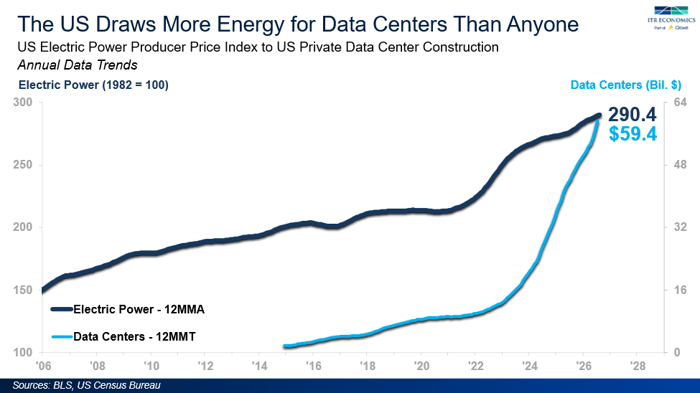
Figure 1: Data center construction has risen sharply alongside higher electric power prices, underscoring the growing infrastructure demands behind the digital economy.
Power Constraints Could Reshape Growth Decisions
Rising electricity demand has implications well beyond the utility sector. Economic growth depends not only on the presence of demand, but also on the physical capacity to support production, distribution, and investment. When power becomes more costly, less reliable, or more difficult to secure, it can alter the economics of expansion. A manufacturer weighing a new facility, for example, must consider whether the local grid can support additional load. A company investing in automation must account for the power requirements that come with new equipment. Even businesses with modest direct electricity needs may face indirect exposure through suppliers, customers, or regional cost pressures.
For that reason, electricity is becoming less of an operational assumption and more of an executive planning issue.
How Businesses Can Plan for a More Energy-Intensive Economy
Incorporate electricity into your capital expenditure plans. Businesses investing in new equipment, cooling systems, electric fleets, or other energy-intensive assets need to understand both the upfront cost of those investments and the operating requirements that accompany them. In some cases, the limiting factor may not be whether the business can afford the investment, but whether the surrounding infrastructure can support it on the desired timeline.
The companies best positioned for the coming years will be those that treat electricity as a strategic variable. That means evaluating energy exposure by location, communicating with utility providers earlier in the planning process, incorporating power costs into financial models, stress-testing growth plans against infrastructure constraints, and undertaking prudent capital expenditures now aimed to increase efficiencies or energy independence to hedge against higher prices in the future. Electricity is no longer merely a line item. For many businesses, it is becoming a constraint to manage, a risk to monitor, and, in some cases, a source of competitive advantage or disadvantage.
Plan for Pressure Ahead
As electricity becomes a more important factor in business planning, leaders need to understand where energy costs, infrastructure constraints, and regional risks intersect with their growth strategy. ITR Economics helps businesses look beyond the headlines and incorporate leading economic indicators into practical, profitable decision-making. Contact us today to discuss how our forecasts can support your long-term planning.
