Growth in US Real Personal Income (excluding current transfer receipts), a measure of inflation-adjusted income that excludes transfer payments like workers compensation or unemployment benefits, slowed to 1.2% (annual trend) for January 2026.
The 1.2% annual rate-of-change is less than half the median annual rate-of-change of 2.7% over the last decade.
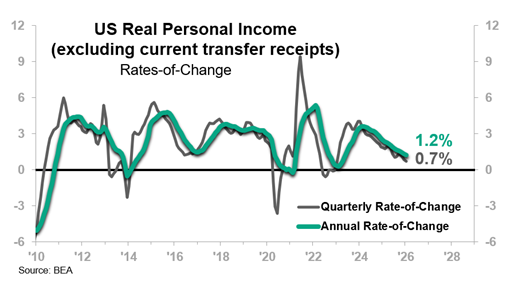
Note that the quarterly rate-of-change is trending below the annual rate-of-change in the chart. This is an unfavorable ITR Checking Point™, and it signals that Income growth is likely to slow further, at least in the near term.
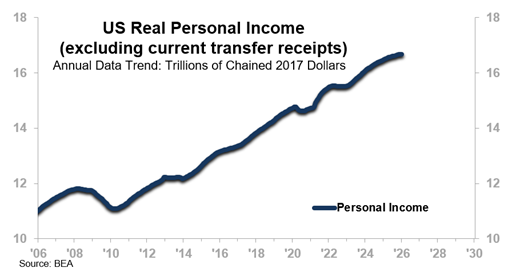
Meanwhile, the rise in the annual total ascent has become less pronounced of late, visible in the next chart as the near flatness in the most recent data.
Why the Trend Is Worth Watching Closely
Consumers are the ultimate source of demand for the economy. While fluctuations between Real GDP and Real Personal Income can and do occur in the near term, Real GDP and Real Personal Income track closely with one another over the longer term. Real Personal Income not only provides a general gauge of consumers’ spending ability, but it also provides a gauge of how that ability is holding up under inflation. When consumer spending is constrained by sluggish Real Personal Income, it has a dampening impact on economic activity, with second-order effects:
- Slower business revenue growth: Companies tied to consumer spending — and, with its indirect but outsized impact on aggregate demand, even our industrial clients are often surprised at the strength of their correlation with consumer spending — may see weakening sales and profits.
- Reduced business investment: Firms delay hiring, expansion, and capital spending due to weaker demand expectations.
- Higher unemployment risk: Businesses may reduce staff or slow hiring when revenue growth weakens.
Another reason the trend is worrisome stems from the Iran conflict and its consequent impact on Oil Prices. If spiking commodities were to have a lasting impact on US Consumer Prices, it could eat more into consumers’ ability to spend elsewhere.
Silver Linings
The current easing trend in Real Personal Income is another sign in support of our expectation that US Real GDP growth will begin to slow in the second quarter of this year, with the trend extending into 2027. Our forecasts for both US Industrial Production and US Nondefense Capital Goods New Orders call for some plateauing (an interruption to the overall rising trend rather than outright decline) in 2027.
While we are watching the Real Personal Income trend very closely, other metrics point to general consumer resiliency:
- US Consumer Debt Service Payments as a Percent of Disposable Personal Income are trending below the pre-COVID level, signaling that consumers’ current obligations are not particularly onerous and that they likely have the capacity to take on additional debt if necessary.
- The US Consumer Credit Card Delinquency Rate is below the long-term average. The US Residential Mortgage Delinquency Rate (over 90 days) is in even better shape. (Note that auto loan delinquency rates are shakier, having passed the pre-COVID level last year and gradually risen since to a 15-year high.)
- The US Number of Unemployed Persons per Job Opening, a useful metric from the US Bureau of Labor Statistics, is still showing resiliency despite labor market softening, coming in at just over one unemployed person per job opening. This, coupled with a sub-5% unemployment rate, signals that work is generally available to those seeking it.
Nuanced Marching Orders for Businesses
The Real Personal Income trend paints a picture of a consumer who is facing some fiscal strain. This is especially so of those on the lower end of the income spectrum. Those on the upper end of the income spectrum are more insulated from inflationary pressures, and may in fact have benefitted in some ways from them provided they are homeowners with low fixed interest rates or own stock portfolios that have seen outsized gains in recent years. Consumers can and will spend, provided there is a strong reason. Your competitive advantages — i.e., the “extras” that distinguish you from your competitors — can help provide that reason. A strong value proposition is also essential; consumers in this environment need to understand that the money they are exchanging for a good or service is going to go as far as possible. Your marketing should assure them that it will.
