The 2030s are getting closer, and our forecast for a depression in the 2030s has not changed. Today's economy is characterized by uneven but positive growth and a relatively resilient, albeit bifurcated, consumer base. Yet beneath the surface, long-term structural pressures continue to build.
The primary pressures at hand:
- Demographic aging
- Rising healthcare costs
- Growing US government entitlement obligations
- Persistent inflationary forces
- Mounting national debt
Together, these forces remain on a collision course. There’s little opportunity in fearing the forecast Instead, use the remaining years of the 2020s to strengthen balance sheets, diversify revenue streams, and invest in resilience. Businesses that prepare today will be best positioned to navigate the challenges coming. A business that’s prepared can thrive — taking market share, buying distressed assets at low prices, etc. — in an economic downturn.
The Five Structural Drivers
Demographics
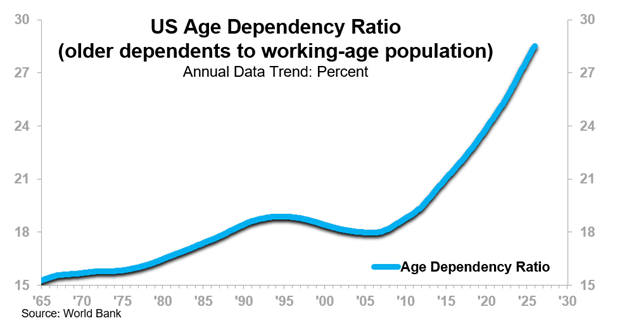
Demographic aging remains the most significant challenge. As baby boomers continue moving through retirement, labor force growth is slowing. A smaller share of working-age Americans is now supporting a growing population of retirees. This creates economic headwinds that affect everything from labor availability to tax revenues to consumer demand. The Age Dependency Ratio is now the highest in the data history at 28.5%, a relatively steep rise from 2005’s 18.0%.
Economic malaise in Japan, China, and Western Europe — each of which are worse off both demographically and economically than the US — offers a clear warning sign that demographics are not to be ignored.
Healthcare
Healthcare costs are expected to continue rising. An aging population naturally consumes more healthcare services, placing additional pressure on both public and private spending. These higher costs ripple throughout the economy, affecting employers, government budgets, and household finances.
Entitlements
Government entitlement obligations are expanding as more Americans qualify for Social Security and Medicare. These commitments represent a growing share (and comprise over one-third) of federal spending, and they are becoming increasingly difficult to finance. Adding Medicaid into the equation pushes the entitlements spending total to around half of all federal spending.
Inflation
Persistent inflationary forces also remain in place. While inflation rates naturally fluctuate over the business cycle, several structural drivers point toward a higher-cost environment over the long term. Labor shortages, limited housing supply, limited electricity supply, nationalism, deficit spending, and rising healthcare expenditures all contribute to upward pressure on costs. It is no accident that the elevated inflation that began in the early 2020s will have been in place by about a decade when the 2030s downturn hits. Think back to the period of inflation in the 1970s, which culminated in a “double dip” (two downturns) recession in the early 1980s. Economists, business leaders, and individuals that ignore this precedent are doing so at their own peril.
National Debt
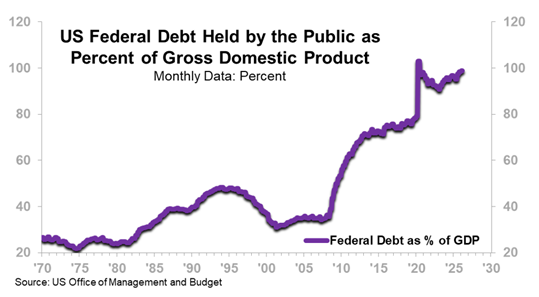
Finally, mounting national debt is reducing the country’s fiscal flexibility. High debt levels do not automatically cause economic contractions, but they limit policymakers' ability to respond effectively during future periods of economic stress. Combined with rising entitlement obligations and slower demographic growth, debt becomes part of a much larger structural challenge. The federal debt held by the public as a percent of GDP is now close to 100%.
None of these trends alone guarantees a depression. Together, however, they create a challenging environment.
Can the Outcome Change?
The natural follow-up question is whether the anticipated depression can be prevented.
Public policy certainly matters. Improvements in productivity, technological innovation, workforce participation, and fiscal discipline could lessen the severity of future economic weakness. However, many of the underlying drivers have been decades in the making. Demographic aging cannot be reversed quickly. Healthcare obligations will likely grow as the population ages alongside entitlement spending. The multitude of inflationary drivers and the debt accumulated over many years cannot disappear overnight.
Because these challenges evolve slowly, businesses should avoid basing long-term strategies on the expectation that policymakers will fundamentally alter the trajectory.
One important clarification is that our forecast does not call for a repeat of the Great Depression of the 1930s. While there are similarities in the long-term structural forces at work, today's economy is fundamentally different. The US economy is more diversified, policymakers have more tools at their disposal, and financial institutions operate under a much different regulatory framework. We anticipate a prolonged period of economic weakness driven by structural headwinds rather than a sudden economic collapse.
Geography Will Matter
Not every region of the country will experience the coming decade in the same way. Population trends already reveal meaningful differences among states. Areas attracting new residents and expanding labor forces will likely experience stronger long-term economic performance than states facing population stagnation or decline. These demographic shifts will influence labor availability, consumer demand, housing markets, and investment opportunities.
Business leaders should evaluate not only national trends but also regional demographic data when making decisions about expansion, hiring, and capital investment.
Preparing Today for Tomorrow
Don’t allow our forecast for the 2030s discourage your investments or create unnecessary concern. Our intention is to provide business leaders with an imperative to prepare. History consistently shows that organizations entering downturns from positions of financial and operational strength outperform those forced into reactive decision-making.
Today's environment remains one in which many companies can improve profitability, strengthen cash reserves, invest in productivity-enhancing technologies, and build organizational resilience. Those actions become significantly more difficult once economic conditions begin to deteriorate. Act now to review debt structures, evaluate capital expenditures, strengthen customer relationships, adjust your risk management strategy, and improve operational efficiency. Consider workforce development and succession planning, as demographic pressures are going to reshape labor markets.
We want to be part of your 2030s strategy. Reach out to us so that we can use our expert forecasting and consulting to optimize your potential heading into the next decade.
