Executive Strategy
The Labor Market, Recession, and ‘People’ Concerns
Some recent developments in the labor market are, on balance, a positive for the overall economy.
Over the years, the Fed and economists have used various inflation metrics. But which measurement provides the most accurate analysis for business planning?
Last week brought a flurry of media pieces about the new Fed chair’s preferred inflation metric and whether or not it is an accurate measure of consumer pricing pressures.
While we take no political position on any messaging in the pieces, we can say we are happy to see the media highlighting one of ITR Economics’ core tenets — that data matters!
At his April 21 confirmation hearing, Kevin Warsh, the new Fed chair, stated that he preferred trimmed averages as a tool to gauge inflation.
Over the years, the Fed and economists have used various inflation metrics. The US Bureau of Labor Statistics’ Consumer Price Index, which we use at ITR Economics, measures a basket of consumer goods. So-called “core” price indexes exclude food and energy prices and are favored by some as measures that filter out what are historically among the most volatile of categories. The Fed, in particular, has historically preferred a Personal Consumption Expenditures-based price index that excludes food and energy. Accordingly, Chairman Warsh’s trimmed average preference represents a potential shift from the norm.
The thought behind trimmed averages is that, rather than filter out historically volatile categories like food or energy, they filter out the volatility itself. The Dallas Fed Trimmed Mean PCE inflation rate is the particular metric that the media focused on last week. This metric:
Looks at the monthly inflation rate (annualized) for each category of PCE (personal consumption expenditures data from the Bureau of Economic Analysis)
Puts those categories in ascending order from what declined the most to what rose the most
And, finally, trims off the bottom 24% of weight (declining or more-slowly rising categories) and the top 31% of weight (the most rapidly rising categories).
Per the Dallas Fed’s methodology, the relative sizes of the trimmed-off portions (also known as “tails”) are based on the central bank’s historical analysis aimed at producing the best fit with proxies for underlying core PCE inflation.
Some argue that the 31%/24% split can understate inflation at times, particularly when upward pressures are atypically intense and concentrated in the upper tail. Looking back at the post-COVID era, one of the more memorable inflation ramp-ups of recent memory, the Dallas Fed Trimmed Mean PCE did show less-pronounced rise than the inflation metrics that we at ITR Economics typically use or that the Fed uses (Core PCE Price Index):
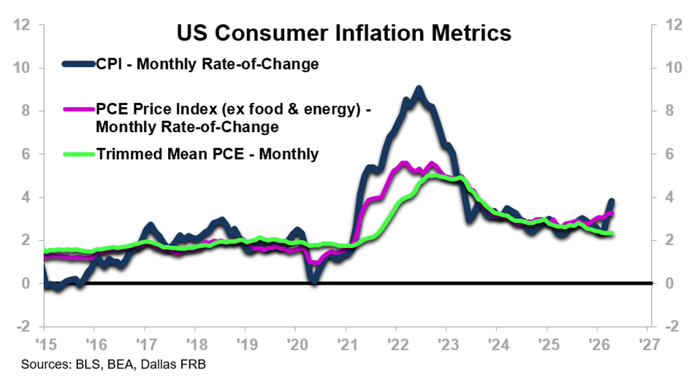
It is important to note that sometimes the Trimmed Mean PCE shows higher inflation than what the other metrics show. This occurred in 2009 and 2015-16. In the above chart, we can see that the initial pandemic-related disinflation was also less visible in the Trimmed Mean metric.
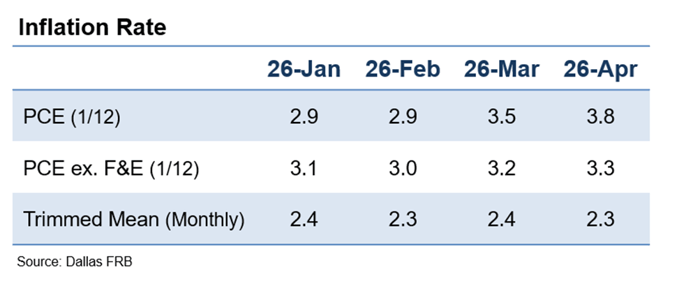
More recently, however, the Dallas Fed Trimmed Mean PCE is showing inflation that is stable to cooling, whereas headline (Personal Consumption Expenditures Price Index including food and energy) and core (excluding food and energy) inflation have risen in recent months.
The recent media attention on Warsh’s statement has a political angle.
The Fed’s dual mandate includes maintaining policy that encourages stability in both employment and inflation. When inflation rates are lower, it ostensibly gives the Fed leeway to adopt more dovish interest rate policies, a move that can have a stimulative effect on the US economy in the shorter term but can lead to higher inflation over the longer term.
The recent media pieces note that apparently lower inflation could give the new Fed chairman justification to push for more dovish interest rate policies than would otherwise be the case; President Trump has stated a desire for lower interest rates.
At ITR Economics we look at multiple metrics of consumer inflation in our analysis. We look at categories such as shelter or food or energy on individual bases. We look at metrics, such as Core CPI, that exclude volatile categories like food and energy, particularly when we are analyzing actions of the Fed or other bodies that sometimes use such metrics.
However, in our Trends Report™, we provide monthly analysis of the US Bureau of Labor Statistics’ US Consumer Price Index, which does not exclude anything. (We also report out on the US Producer Price Index, which is a similarly broad pricing gauge for manufacturers as opposed to consumers). We tend to favor metrics that are unadjusted and comprehensive, and the Consumer Price Index is closest to meeting these criteria. Such metrics enable us to provide the most complete and unbiased analysis for our clients.
Also note that we do not rely solely on inflation metrics to assess and track consumer health. Measures such as retail sales, job openings, credit delinquencies, real personal income, and others help us provide our readers with the most accurate and comprehensive view of consumer health that we are able to analyze.
As for the Fed, we do not forecast policy decisions. However, we do watch the Fed and related developments very closely, and we analyze the central bank’s decisions and its governing members’ statements in light of the latest economic developments and trends. We share our analysis and observations in our weekly show, Fed Watch, with ITR Economist Lauren Saidel Baker. This week she will be discussing the Dallas Fed Trimmed Mean PCE. We encourage you to tune in — and keep following ITR Economics for unbiased and apolitical analysis.

Some recent developments in the labor market are, on balance, a positive for the overall economy.
With the Federal Reserve Board lowering interest rates in September, what are the positive and negative ways the cuts could impact the US consumer?
Media noise distracts from the only thing that matters when it comes to assessing the state of the economy: actual data